
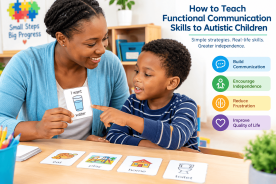
Your child already has something to say. Let’s help the world understand it.
If you have ever stood in a kitchen while your child tugged your sleeve, cried, or pulled you toward the fridge, and felt that mix of love and helplessness because you couldn’t quite work out what they needed, this article is for you.
I want to start with something that changed how I think about this topic: every child communicates. The child dragging you to the cupboard, the child covering her ears, the boy repeating a line from his favorite show: each of them is telling you something. For many autistic children, the challenge is not having nothing to say. It’s that their ways of saying it are unconventional, hard for others to read, or not yet dependable enough to get their needs met.
So let’s talk about how to build those tools together, gently and step by step.
What Functional Communication Really Means
Functional communication is communication that works. It gets a result. A snack arrives, a loud noise gets turned down, a trusted adult comes closer.
The form it takes can vary enormously: spoken words, signs, gestures, pictures, a speech-generating device, written words, or a blend. What matters is not how polished it sounds, but whether your child is understood.
The main jobs communication does include:
- Requesting: asking for items, actions, attention, or help
- Rejecting: saying “no,” “stop,” or “I don’t want that”
- Asking for a break: signaling that something is too much
- Commenting: sharing interest (“look!”) rather than only asking for things
- Answering and asking questions: joining a back-and-forth
- Expressing feelings: showing or naming frustration, joy, or worry
Most children benefit from starting with requesting and rejecting, because those skills quickly reduce frustration. Commenting and conversation follow, and they matter just as much, because they are about connection rather than just needs.
Why This Matters So Much
When a child has no dependable way to communicate, behavior often fills the gap. Hitting, screaming, dropping to the floor, or bolting can be the most effective message available. And because adults naturally respond to those behaviors, the child learns that they work.
Research into functional communication training has repeatedly found that when a child learns a clear, efficient replacement for a challenging behavior, that behavior often decreases. We aren’t trying to silence your child. We’re giving them a better way to be heard.
Beyond behavior, communication supports safety, learning, independence, friendship, and self-advocacy. At its heart it’s about dignity. Every child deserves to be listened to.
Step 1: Get Curious About How Your Child Already Communicates
Before you teach anything new, become a detective for a few days. Jot down brief notes on:
- What your child does (reaches, cries, pulls your hand, echoes a phrase, looks at an object)
- What they seem to want (an item, an escape, attention, sensory input)
- What happens next (how you or others respond)
You’ll probably find your child is communicating far more than you realized. Treat those behaviors as your starting point. If your child leads you to the fridge, that is a request, and our job is to shape it into something clearer and more flexible rather than ignore it.
Also notice what lights your child up: favorite snacks, songs, spinning toys, swings, or a particular person. Children learn to communicate most readily when they truly care about the outcome.
Step 2: Choose a Communication Mode That Fits Your Child
There is no single right system. The best choice depends on your child’s motor skills, hearing, vision, attention, and preferences, and a speech-language pathologist (SLP) can help you decide. Common options include:
Spoken language. Many children develop speech with support, and it can be encouraged alongside other methods.
Signs and gestures. Signs are quick to learn and always with your child, though the people around them need to understand them.
Picture-based systems. Approaches like the Picture Exchange Communication System (PECS) teach a child to hand over a picture to request something. Picture boards and visual schedules also help with understanding and predictability.
AAC devices. Augmentative and alternative communication (AAC) includes tablets and dedicated devices that speak a word when your child touches a symbol. Modern AAC can support rich, flexible language, including for children who may never rely mainly on speech.
If you’re worried that AAC will stop your child from speaking, you’re not alone. It’s one of the most common fears parents have. The research doesn’t support it. Evidence suggests AAC often supports speech development rather than blocking it, and it gives your child a reliable voice right now.
You can also offer more than one mode. Your child might use a device at school, a few signs at home, and spoken words when they feel relaxed. Flexibility is a strength.
Step 3: Start With Requests Your Child Truly Wants
The first messages to teach are the ones that pay off immediately. Choose something your child loves and try this:
- Set the scene. Place a favorite item where your child can see it but not reach it, or put it in a clear container.
- Wait. Pause with an expectant, friendly look for several seconds. This “time delay” gives your child room to start the conversation.
- Offer a prompt if needed. Show the sign, point to the picture, or model the word.
- Respond right away. Hand over the item with real enthusasm. Fast, dependable rewards teach your child that communication works.
- Fade your help gradually. Over time, offer less support so your child does more on their own.
Keep practice short and playful. A few joyful exchanges woven into play are worth far more than a long, tense drill. And please never withhold food, water, comfort, or safety to force a response. Teaching should feel like a game that opens doors, not a test.
Step 4: Teach “No” and “Break” (They’re Just as Important)
Many families teach “more” and “want” first and forget that being able to say “no” matters just as much. If a child can’t refuse clearly and safely, they may turn to stronger behavior to be heard.
Offer two choices and honor the answer. When your child pushes something away or signals “no,” respond respectfully: “Okay, no thank you.” That tells them communication is safe.
Teach a clear way to ask for a break, whether that’s a card, a sign, or a button on a device, and then honor it often. If your child asks for a break and it’s usually respected, the signal gains power. Later, you can gently stretch the time between breaks, but only after trust is built.
“Help” is another gift. Set up small, solvable problems, like a sealed container with a favorite toy inside, so your child can practice asking for assistance.
Step 5: Weave Communication Into Everyday Life
Skills taught only at a table often don’t carry over into real life. The most lasting learning happens in the middle of daily routines: meals, bath time, dressing, play, and outings. Look for small openings:
- At snack time, offer small portions so your child needs to ask for more.
- Pause a favorite game, like tickles or bubbles, and wait for your child to signal “again.”
- While getting dressed, offer a choice of two shirts.
- On a walk, point out something interesting and model a comment.
And use your child’s system yourself. If they use an AAC device, touch the symbols as you speak so they can see how it works. This is often called aided language input. You aren’t demanding a response. You’re demonstrating, much as typically developing children hear thousands of spoken words before saying their own.
Step 6: Grow From Requests to Comments and Conversation
Once your child reliably requests and rejects, widen the circle. A child who only asks for things may come to think that’s all communication is for. Gradually introduce:
- Commenting. Model short comments like “look,” “big,” or “my turn,” and celebrate when your child shares an interest.
- Answering questions. Begin with simple, concrete ones (“What do you want?” “Where’s the ball?”) and make sure your child has a way to answer.
- Asking questions. Teach “what’s that?” or “where?” with a visual cue.
- Naming feelings. Use feeling cards, and name your own feelings out loud: “I feel happy,” “I’m frustrated, I need a minute.”
A word about echolalia, the repetition of words or phrases. Many autistic children use echoed language meaningfully, borrowing a line from a favorite video to express a mood or make a request. Rather than discouraging it, try to work out what it means, respond to that meaning, and offer a flexible alternative when the moment is right.
Step 7: Set Up a Communication-Friendly Environment
You can support learning enormously through the world around your child.
Keep the system within reach. A communication board in a drawer helps no one. Make sure your child’s device, pictures, or signing partners are available all day: at home, at school, in the car.
Use visual supports. Visual schedules, first-then boards, and labeled bins reduce confusion and anxiety, and they give your child something to point to.
Soften sensory overload. A child overwhelmed by noise or bright light may not be able to reach any of their skills. Adjust what you can.
Give processing time. Many autistic children need extra seconds to take in what was said and plan a reply. Count silently to ten before repeating or rephrasing.
Teach the whole circle. Grandparents, siblings, teachers, and babysitters all need to understand and respond to your child’s system. Consistency across people helps skills carry over.
Step 8: Respond Consistently and Celebrate Every Attempt
The most powerful teaching tool you have is how you respond. Honor every genuine attempt to communicate, even imperfect ones. If your child says “ba” for ball, give them the ball and say “ball.” If their sign for “more” is a little messy, accept it and show the clearer version.
Consistency matters because children learn from what happens next. If communication works sometimes and is ignored at other times, a child may escalate to behaviors that are more reliable. When your response is dependable, their confidence grows.
Keep correction gentle. Rather than “No, say it properly,” try expanding what they offered: “You want juice! Juice, please.” The tone stays warm, and communication stays safe.
You Don’t Have to Do This Alone
A speech-language pathologist can assess your child’s abilities, recommend a communication system, and coach you through strategies. Occupational therapists can help with motor and sensory needs, and behavior analysts or other specialists can help when challenging behavior is part of the picture. If your child is in school, ask that communication goals be written into their individualized education program (IEP) or equivalent plan, and that their system be used across the school day.
Don’t be shy about asking professionals to explain what they’re doing and why. The best support is collaborative, built around your child’s strengths and interests, and respectful of your family’s values.
Common Pitfalls to Avoid
- Waiting for speech before trying anything else. Early access to a communication system helps, and delays can add frustration.
- Over-quizzing. Constantly asking “What’s this? What color?” can make communication feel like a performance instead of a way to connect.
- Reading behavior as defiance. Ask what the behavior might be saying before deciding how to respond.
- Ignoring your child’s preferences. A system that doesn’t suit your child won’t get used.
- Expecting steady, straight-line progress. Skills come in bursts, plateau, and may look different across settings. Patience pays off.
- Chasing compliance. The goal is a child who can express themselves, including saying no, not one who only follows directions.
A Note on Respect
Teaching functional communication is not about making an autistic child seem less autistic. It’s about widening the ways they can share their inner world and take part in their own life. Many autistic adults stress that the goal should be understanding and access, not forced eye contact or scripted social behavior. Seek out autistic voices, including self-advocates who communicate through AAC, as you shape your approach. They remind us that a child who doesn’t speak is not a child with nothing to say.
Your Simple Starter Plan
If you’re not sure where to begin, try this over the next few weeks:
- Observe your child for several days and note how they communicate and what they love.
- Consult an SLP about the best mode.
- Pick two or three motivating requests to teach first, plus one way to ask for a break.
- Practice in short, playful bursts several times a day, built into routines.
- Model the system yourself as you talk, without demanding responses.
- Respond quickly and consistently to every attempt.
- Share the plan with everyone in your child’s life.
- Review every few weeks and add comments, questions, and new vocabulary as your child is ready.
Final Thoughts
Functional communication is one of the most meaningful gifts you can help an autistic child build. It turns frustration into connection, confusion into choice, and silence into conversation, however that conversation happens. The path may include setbacks, but every successful request, every honored “no,” and every shared moment of attention is a step toward a child who feels understood.