
A Complete, Research-Based Guide for Parents and Teachers
Introduction: When Silence Raises Questions
It can be deeply concerning when a child isn’t speaking as expected. You may notice that other children are forming words, asking questions, or expressing needs—while your child remains silent or uses very limited speech.
Here’s the reality: speech delay is more common than many people think, and it does not always mean something serious. However, in some cases, it can signal underlying developmental, medical, or environmental issues that require attention.
Research shows that speech and language delay affects a notable percentage of children, and if left unaddressed, it may lead to long-term social, emotional, and academic challenges.
The key is this:
Understanding the cause determines the solution.
In this article, we will break down:
- Why some children don’t speak
- The most common causes (backed by research)
- Clear signs to watch for
- What you should do—step by step
The Real Reasons Some Children Don’t Speak
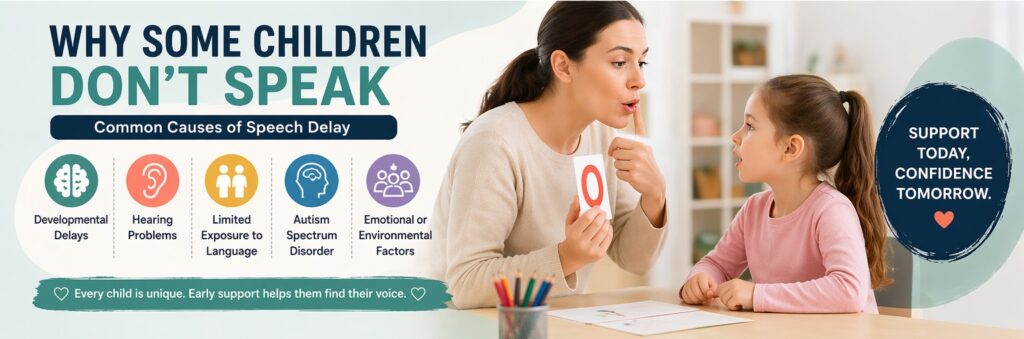
There is no single cause of delayed speech. Instead, it is usually the result of a combination of biological, developmental, and environmental factors.
1. Hearing Problems (One of the Most Overlooked Causes)
Children learn to speak by hearing sounds, words, and conversations. If hearing is impaired—even slightly—speech development can be delayed.
- Hearing loss can prevent children from understanding sounds correctly
- Even temporary issues (like fluid in the ear) can affect speech learning
- It is considered one of the most well-documented causes of speech delay
If a child cannot hear clearly, they cannot imitate speech effectively.
Warning Signs:
- Does not respond to name
- Turns to visual cues instead of sounds
- Seems to ignore speech
2. Autism and Developmental Disorders
Speech delay is often associated with neurodevelopmental conditions, especially autism spectrum disorder.
Children with autism may:
- Have delayed or absent speech
- Struggle with social communication
- Show limited interest in interaction
Research indicates that speech delay frequently occurs alongside autism and other developmental disorders.
However, it’s important to understand: Not all speech delays mean autism—but it is one possibility that should be evaluated.
3. Oral-Motor and Physical Difficulties
Some children want to speak but physically struggle to do so.
This can be due to:
- Poor coordination of lips, tongue, and jaw
- Conditions like apraxia of speech
- Muscle control challenges
These are known as oral-motor disorders, and they make it difficult for a child to produce clear sounds.
Signs:
- Difficulty chewing or swallowing
- Drooling beyond infancy
- Sounds that are unclear or inconsistent
4. Lack of Stimulation and Environmental Factors
Speech does not develop in isolation—it requires interaction, exposure, and engagement.
Studies show that inadequate stimulation and limited communication environments can significantly contribute to speech delay.
Examples include:
- Limited talking at home
- Excessive screen time
- Few opportunities for interaction
Children learn language through human connection, not passive listening.
5. Genetic and Family Factors
Speech delays can sometimes run in families.
Research highlights:
- Genetic influences (such as specific language-related genes)
- Family history of delayed speech
- Neurodevelopmental inheritance patterns
If a parent or sibling had delayed speech, the child may follow a similar pattern.
6. Multilingual Environment (Often Misunderstood)
Growing up in a multilingual home can sometimes appear like a delay, but it is often not a true disorder.
- Children may take longer to organize multiple languages
- Total vocabulary across languages may be normal
However, studies note that multilingual environments can sometimes be perceived as a risk factor if not properly assessed.
Important: This is usually temporary and not harmful.
7. Medical or Neurological Conditions
Some children experience speech delays due to:
- Brain injuries
- Cerebral palsy
- Seizure disorders
- Developmental delays
These conditions affect how the brain processes and produces language.
When Should You Be Concerned?
Not every delay is a problem—but some signs should not be ignored.
Red Flags:
- No babbling by 12 months
- No words by 18–24 months
- Loss of previously learned speech
- Difficulty understanding simple instructions
- No eye contact or social interaction
- Early detection is critical. Delayed intervention can lead to long-term developmental challenges.
What To Do If Your Child Isn’t Speaking
Now the most important part: action.
1. Get a Hearing Test Immediately
This should always be the first step.
Why? Because hearing issues are:
- Common
- Often treatable
- Easily overlooked
A simple hearing test can rule out a major cause.
2. Consult a Speech-Language Specialist
A speech therapist can:
- Assess communication abilities
- Identify underlying issues
- Create a structured intervention plan
Research emphasizes that early, multidisciplinary evaluation leads to better outcomes.
3. Increase Daily Interaction (This Is Powerful)
The most effective “therapy” often starts at home.
Do this daily:
- Talk to your child constantly
- Narrate actions (“We are eating now”)
- Read books aloud
- Encourage imitation
Language grows through interaction, repetition, and engagement.
4. Reduce Passive Screen Time
Screens do not replace human interaction.
Children need:
- Eye contact
- Facial expressions
- Real conversations
Replace screen time with interactive play and communication.
5. Use Visual and Assistive Communication Tools
For children who struggle to speak:
- Picture cards (PECS)
- Gesture-based communication
- Assistive apps
These tools help children communicate before speech develops, reducing frustration.
6. Create Opportunities to Communicate
Avoid anticipating every need.
Instead:
- Wait for the child to request
- Offer choices (“Do you want milk or water?”)
- Encourage pointing or sounds
This builds the motivation to communicate.
7. Be Consistent and Patient
Progress may be slow—but it happens.
Some children:
- Catch up naturally
- Improve with therapy
- Develop speech later than peers
In fact, research shows that many children with delays improve significantly with time and support.
What Many Parents Get Wrong
Understanding these mistakes can save time and frustration:
– “Let’s wait, they will talk eventually”
→ This delays early intervention
– Comparing children
→ Every child develops differently
– Over-relying on screens
→ Reduces real communication opportunities
– Ignoring early signs
→ Missed early treatment window
Real Insight from Parents
Many parents report similar experiences:
Some children communicate in other ways (pointing, gestures, sounds) before speaking.
Others notice:
- Speech improves after age 3
- Therapy makes a major difference
- Social interaction plays a key role
The journey is different for every child—but progress is possible.
The Good News: Speech Can Improve
Here’s what you need to remember:
- Speech delay is not a life sentence
- Many children catch up with support
- Early action dramatically improves outcomes
The brain is highly adaptable—especially in early childhood.
Points to Remember
If your child is not speaking, don’t panic—but don’t ignore it either.
The most important steps are:
- Identify the cause
- Take early action
- Stay consistent
Speech is not just about talking—it’s about connection, learning, and independence.
Quick Summary
Why children may not speak:
- Hearing problems
- Autism or developmental disorders
- Oral-motor difficulties
- Environmental factors
- Genetics
- Medical conditions
What to do:
- Test hearing
- See a specialist
- Increase interaction
- Reduce screen time
- Use communication tools